

Reach trucks and order pickers can look similar in a busy warehouse, but they are engineered for different jobs. For most sites, the right hire choice comes down to what your operation does most often: put away and retrieve pallets in racking, or pick individual items/cases for customer orders. That’s the practical question behind reach truck hire vs order picker—and it affects throughput, aisle congestion, and safety.
What each truck is designed to do
A reach truck is a warehouse forklift built for pallet handling in racking. The UKMHA guide describes reach trucks as carrying the load partly within the chassis, with a mast that “reaches” out and in to place and recover a pallet—supporting narrow-aisle operation and high stacking. The same guide also describes reach trucks as typically battery-powered and intended for indoor use on smooth floors.
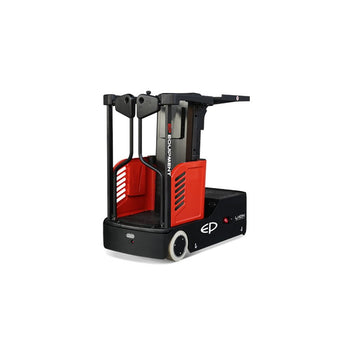
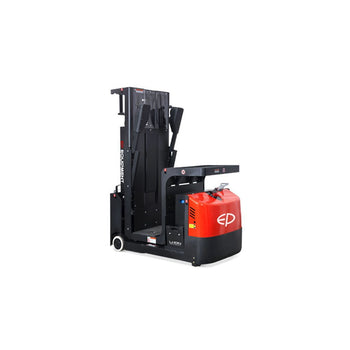
An order picker is designed to maximise order picking operations. Order pickers range from low-level trucks (often closely related to electric pallet truck designs) through to vertical machines that raise the operator platform to pick from upper shelf levels. UKMHA also notes that floor condition is critical for safe operation of high-level order picking equipment, which is a key difference when comparing trucks for “working at height” tasks.
In short: reach trucks move pallets in and out of racking; order pickers bring the operator to the pick face for cartons and cases.
When a reach truck is the better hire
Hire a reach truck when your bottleneck is pallet put-away, replenishment, or retrieval at height—especially in racked storage with limited aisle space. UKMHA highlights reach trucks’ narrow-aisle usefulness and notes they can be configured to lift to around 12 metres (depending on the model).
On iLift’s hire range, the EP CQD16/20L reach truck option is shown with 1.6–2.0 tonne capacities and triplex mast options of 6,500 mm or 9,000 mm—typical for reserve storage and high-bay put-away work. These models are from EP Equipment.
A key constraint: reach trucks are primarily indoor, smooth-floor machines. If your operation crosses uneven thresholds, ramps, dock transitions, or outdoor ground, treat surface condition as part of the hire specification and your risk assessment—not an afterthought.

When an order picker is the better hire
Hire an order picker when your performance is driven by pick speed and accuracy—particularly for “eaches” or split cases across multiple shelf levels. iLift’s order picker FAQ says order pickers are typically designed for picking individual items or cases from shelves and can improve productivity and reduce ladder use (with associated safety benefits).
This is where order picker forklift uses matter. Common uses include e-commerce/retail fulfilment with many SKUs per order, replenishing shelf locations, cycle counts at height, and maintenance tasks that need controlled access to racking without ladders.
iLift’s vertical order picker range includes the EP JX0 and EP JX1. The JX0 is presented with a platform height around 2.99 m (3 m working height) and hire listed from £100 per week. The JX1 page also lists hire from £100 per week and describes configurations capable of reaching picking heights up to 6.3 m (platform height 4.8 m), depending on model variant.
How to choose between them before you hire
Start by mapping tasks to the “unit of work”. If most movements are full pallets into/out of racking, lead with a reach truck; if most movements are cases/eaches, lead with an order picker. If you’re unsure, sample a peak shift and measure how much time is spent on put-away versus picking today.
Then confirm the physical constraints that can make or break the hire: required lift height, aisle manoeuvrability, and floor quality. UKMHA flags floor condition as a critical safety factor for high-level picking; iLift’s range pages also emphasise narrow-aisle suitability and manoeuvrability.
Before you book, be ready to share: maximum load weight and pallet dimensions, highest pick/put-away beam, minimum aisle width, floor condition (ramps/thresholds), and shift pattern. This aligns to the HSE expectation that training includes job-specific elements and familiarisation on the equipment and in the workplace where it will be used.
Finally, plan how goods will flow between zones. Order pickers typically should not be used as long-distance transporters, so you’ll usually want separate equipment (often pallet trucks) to move pallets and picked loads between receiving, pick faces and despatch.
If you run both pallet storage and split-case picking (common in mixed B2B and e-commerce operations), the highest-performing setup is often a combination: a reach truck to handle reserve pallet moves and replenishment into pick faces, an order picker for item-level picks at height, and pallet trucks for staging and despatch runs.

Safety, training, and compliance
In the United Kingdom, duties apply whether you hire or own. PUWER requires employers to ensure people using work equipment have adequate training (Regulation 9).
Health and Safety Executive (HSE) guidance sets out three stages of lift-truck operator training—basic, specific job training and familiarisation—and warns against assuming competence on new truck types without conversion training. This is highly relevant when switching between reach trucks and order pickers, which can have different stability/visibility characteristics and different “working at height” exposure.
LOLER also matters: HSE explains it places duties on those who own, operate or control lifting equipment and expects lifting operations to be planned and supervised. For equipment used to lift people, HSE indicates a 6‑monthly thorough examination interval (unless an examination scheme specifies otherwise), which can be relevant for man-up order pickers.
For “operator up” tasks, have a realistic rescue plan. HSE guidance covering emergency rope evacuation systems emphasises risk assessment and competent training, and frames rope evacuation as a last resort when safer rescue/lowering isn't practicable.
Find the Right Truck for Your Warehouse Today
To build a “high stacking” hire package, start with iLift’s Electric Reach Trucks range and compare the EP CQD16/20L configurations (1.6–2.0 tonne capacity; mast options shown at 6,500 mm and 9,000 mm on the hire listing).
To build a “fast picking” hire package, start with iLift’s Electric Order Pickers range, including the JX0 and JX1 (both listed from £100 per week).
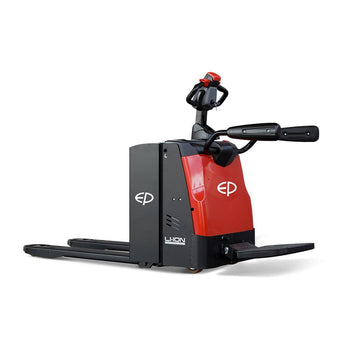
To keep pallets and picks moving, pair either option with pallet trucks. iLift’s current range includes the F Series (hire listed from £60 per week), pedestrian trucks like the EPL1531 (rental from £150 per week), the ride-on RPL201/251/301 series (rental from £180 per week), and pedestrian models such as the WPL202 (2,000 kg; rental from £180 per week).
If you’re unsure whether you need a short hire or a longer term, iLift’s hire guidance describes flexible periods from one-day rental through to longer contracts, with delivery and support through the hire period.
For quotes and availability, use iLift’s hire enquiry form to select a truck type and enter rental dates and site details.