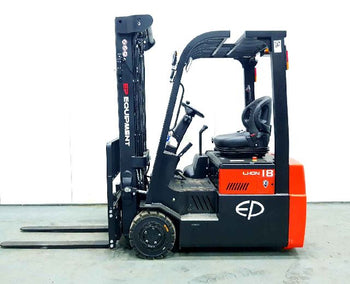


Buying a forklift outright isn't always the right call, and most UK businesses don't do it. Forklift finance spreads the cost of getting the right truck on site without tying up capital that could be used elsewhere in the business. The trouble is that "finance" covers several quite different products, and picking the wrong one can leave you with the wrong asset, the wrong maintenance burden, or the wrong exit route at the end of the term.
This guide walks through the three main routes: leasing, hire purchase, and contract hire, and sets out where each one makes sense.
Why forklift finance matters
A new electric forklift can run into five figures, and lithium-ion trucks with fast or opportunity charging capability sit at the higher end of that. Very few operations want to write that cheque in one go, especially when the truck is a working asset rather than a long-term investment like a building.
Finance also lets you match the cost of the truck to the revenue it helps generate. If the forklift is earning its keep on the warehouse floor from day one, it makes sense for the payments to be spread over the same period rather than front-loaded as a single capital outlay.
The three options below differ mainly in who owns the truck, what happens at the end of the agreement, and who carries the risk on maintenance and resale value.
Forklift lease finance
Leasing is essentially a long-term rental agreement structured for finance purposes. You pay a fixed monthly amount over an agreed term, typically three to five years, and the finance company retains ownership of the truck throughout.
Key features of forklift leasing:
-
Lower upfront cost than hire purchase, often just the first payment
-
Fixed monthly payments make budgeting straightforward
-
VAT-registered businesses can usually reclaim VAT on the payments
-
At the end of the term you typically hand the truck back, extend the lease, or move on to a new agreement
-
You never own the asset, so it doesn't sit on your balance sheet as a fixed asset
Leasing suits businesses that want to keep their fleet current and avoid the hassle of disposing of an ageing truck. It's a good fit if your throughput or shift patterns are likely to change over the next few years, since you're not locked into owning a specific truck long after it's stopped being the right fit.

Forklift hire purchase
Hire purchase, usually shortened to HP, works differently. You pay a deposit followed by fixed monthly instalments, and once the final payment is made, ownership of the forklift transfers to you.
Key features of forklift hire purchase:
-
You own the truck outright at the end of the agreement
-
Deposits are typically higher than a lease's initial payment
-
The truck appears as an asset on your balance sheet, with depreciation accounted for accordingly
-
Total cost over the term is often lower than leasing, since you're building equity rather than paying for use
-
You carry the resale or disposal risk once the agreement ends
Forklift lease vs HP really comes down to whether you want to own the asset. If the truck will still be doing useful work in your operation after the finance term ends, and you're happy to manage its eventual resale or scrappage, HP is usually the more cost-effective route. If you'd rather cycle onto newer equipment every few years without worrying about resale, leasing tends to make more sense.

Contract hire for forklifts
Contract hire sits closer to a full-service rental than either lease or HP. You pay a fixed monthly rate that typically bundles in servicing, maintenance, and sometimes tyres, and the finance and maintenance costs are combined into one predictable figure.
Key features of forklift contract hire:
-
Maintenance and servicing are usually included, reducing unplanned costs
-
No ownership at any point, and no disposal responsibility
-
Monthly costs are higher than a bare lease payment, but they cover more
-
Well suited to businesses that want cost certainty and minimal admin
-
Often flexible on term length and can include options to swap or upgrade trucks
Contract hire is popular with operations running mixed fleets or multiple sites, where the administrative overhead of managing separate service contracts and finance agreements for each truck becomes a real cost in itself. It's also a sensible choice if your maintenance team doesn't have deep experience with a particular truck type, such as a newer lithium-ion model, and you'd rather that risk sat with the supplier.
Comparing the three options
|
Factor |
Lease |
Hire Purchase |
Contract Hire |
|
Ownership at end |
No (return or renew) |
Yes |
No |
|
Upfront cost |
Low |
Higher (deposit) |
Low |
|
Maintenance included |
Not usually |
Not usually |
Often included |
|
Balance sheet impact |
Off balance sheet |
Asset and liability recorded |
Off balance sheet |
|
Best for |
Fleets that need refreshing regularly |
Long-term ownership |
Cost certainty and reduced admin |
Questions to ask before you commit
Before signing any forklift finance agreement, it's worth working through a few practical points:
-
How long do you actually need the truck for? A five-year lease on a truck you'll outgrow in eighteen months is poor value regardless of the monthly rate.
-
What's included in the monthly figure? Servicing, breakdown cover, and tyres can be bundled in or billed separately depending on the agreement, and this materially changes the true cost.
-
What happens at end of term? Return conditions on leases and contract hire agreements can include charges for excess wear, so it's worth reading these carefully.
-
Does the truck suit your operation for the whole term? If you're considering a lithium-ion forklift with opportunity charging, check that your shift patterns and charging infrastructure will still fit in three to five years' time.
-
Is VAT treatment relevant to your business? Leasing and contract hire payments are typically treated as an allowable expense for VAT purposes, whereas HP has different tax treatment as an asset purchase. Speak to your accountant before deciding.
Getting the right advice
None of these options is universally "best." A growing business that expects its throughput and fleet size to change will usually be better served by leasing or contract hire, while an operation with stable, predictable needs and a maintenance team that can look after the truck may find hire purchase works out cheaper over time.
The right answer also depends on the truck itself. A straightforward counterbalance forklift for occasional use has different finance considerations to a lithium-ion truck running multiple shifts with opportunity charging, where uptime and battery performance carry more weight in the decision.
[IMAGE: Warehouse aisle with an EP forklift working alongside racking, showing the truck in daily operation]
Talk to iLift about forklift finance
iLift supplies and hires EP lithium-ion electric forklifts across the UK, and can talk you through which finance route fits your operation, budget, and growth plans. Whether you're weighing up a forklift lease vs HP, want the simplicity of contract hire, or you'd rather start with a flexible hire agreement before committing to finance, take a look at iLift's forklift hire and forklift sales pages, or get in touch to discuss the right option for your fleet.