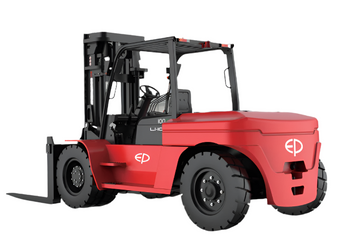


Specifying forklifts for a new warehouse is one of those jobs that looks simple on paper and gets complicated fast. You need trucks that fit the racking, suit the floor, handle the throughput, and don't blow the budget on energy and maintenance for the next five years. Get the spec wrong and you're either paying for capacity you don't use or discovering six months in that your aisles are too tight for the mast you chose.
This guide walks through the practical process of specifying forklifts new warehouse operations actually need, from working out load and lift requirements through to charging infrastructure and fleet sizing.
Start with the building, not the truck
Before anyone talks about make or model, the warehouse itself sets most of the parameters. Three measurements matter more than any spec sheet: aisle width, racking height, and floor loading.
Aisle width determines whether you're looking at a standard counterbalance truck, a reach truck, or a very narrow aisle (VNA) machine. Counterbalance trucks typically need aisles of 3.5 to 4 metres to turn and stack. Reach trucks bring that down to around 2.7 to 3 metres. VNA trucks can operate in aisles under 1.8 metres, but they come with a higher price tag and usually need guided rail or wire systems.
Racking height dictates lift height and mast type. A duplex mast might suit a single-tier pallet store, but multi-tier racking above 6 metres usually calls for a triplex mast with free lift, so the truck can raise a load without the mast itself growing taller than the building.
Floor loading and surface affect tyre choice and axle configuration. Older buildings with uneven or lower-rated floors need this checked against the truck's laden weight, particularly for heavier counterbalance models.

Work out your load profile properly
Don't spec a forklift to the biggest load you'll ever move. Spec it to the load you'll move most often, then check it against the outliers.
Pull together:
-
Typical pallet weight across your most common SKUs
-
Maximum pallet weight for the heaviest lines you'll stock
-
Load centre (the standard is 500mm, but oversized or irregular pallets shift the centre of gravity and reduce a truck's rated capacity)
-
Load dimensions, particularly where you're handling non-standard pallets, cages, or stillages
A truck rated at 2,000kg at a 500mm load centre won't lift 2,000kg at 600mm. Capacity de-rates as load centre increases, so if your pallets regularly overhang, you need a truck specified with that in mind, not one that's technically rated for the weight alone.
Decide on lithium-ion early, not as an afterthought
This is where a lot of new warehouse specs go wrong. Battery type gets treated as a line item to sort out later, when it should be one of the first decisions, because it affects building design.
Lead-acid batteries need a dedicated charging bay with ventilation, eyewash stations, and spill containment, plus space to store spare batteries if you're running multiple shifts. That's floor space and infrastructure cost baked into the building from day one.
Lithium-ion forklifts remove that requirement entirely. There's no off-gassing during charge, no separate ventilated room, and no battery swap process. Trucks charge opportunistically during breaks, at the end of a shift, or overnight, and go straight back to work without a warm-up period. For a new warehouse, that means:
-
No dedicated battery room, freeing up racking or operational space
-
Simpler electrical infrastructure, since charging points can sit near where trucks are used rather than in one centralised bay
-
Multi-shift operations without a second battery per truck
-
Lower long-term maintenance, since lithium batteries have no watering, equalising charges, or terminal corrosion to manage
If you're specifying for a two or three-shift operation, lithium changes the fleet maths too. A lead-acid fleet running multiple shifts often needs spare batteries and a changing schedule built around them. A lithium fleet can be sized closer to the actual number of trucks needed on the floor at any one time, because opportunity charging keeps them topped up between tasks.
[IMAGE: Close-up of a lithium-ion forklift charging point mounted on a warehouse wall, no battery room visible]
Match truck type to the operation, not the other way round
Once aisle width, load profile, and battery type are settled, the truck type usually narrows itself down:
Counterbalance forklifts suit wider aisles, mixed indoor and outdoor use, and general goods-in or dispatch work where trucks are loading vehicles as often as they're working racking.
Reach trucks are the standard choice for narrower aisle pallet racking where maximising storage density matters more than outdoor manoeuvrability.
Very narrow aisle trucks make sense where floor space is at a genuine premium and racking height justifies the extra capital cost, typically in purpose-built distribution centres.
Pallet trucks and stackers cover lower-intensity movement, order picking, or supplementary tasks alongside the primary lift trucks, and are often the most overlooked line in a new spec.
Don't default to counterbalance because it's familiar. In a new build, you're not retrofitting round an existing layout, so it's worth designing the racking and aisle widths around the most efficient truck type for the throughput you expect, rather than the other way round.
Size the fleet against realistic throughput, not peak-day guesswork
Fleet sizing is where over-specification quietly costs the most money. A common mistake is sizing the fleet to cope with the busiest day of the year, which leaves trucks sitting idle for the other 350.
A more useful approach is to model:
-
Average daily pallet movements against a realistic cycle time per truck
-
Peak periods and whether short-term hire can cover seasonal spikes instead of owning extra trucks year-round
-
Shift patterns, since opportunity-charged lithium trucks can often cover a second shift without adding a truck, where lead-acid fleets typically can't
-
Downtime allowance for servicing, since a fleet with zero spare capacity means any truck off the road stops a line
For a new warehouse without operating history to draw on, it's worth building in a short review point, typically three to six months after go-live, to check actual utilisation against the original spec and adjust the fleet size before committing to further purchases.

Don't overlook attachments and visibility
Two areas that get missed in early-stage specs:
Attachments. Fork positioners, sideshifters, and clamp attachments all add weight and reduce rated capacity slightly. If attachments are needed from day one, spec the truck with that de-rating already factored in, not discovered after delivery.
Operator visibility. Mast design, especially on triplex trucks at height, can restrict sightlines. For high-throughput operations, cameras or additional mirrors are worth specifying upfront rather than retrofitting once a near-miss forces the issue.
Bringing it together
Specifying forklifts for a new warehouse works best as a sequence: building constraints first, load profile second, battery type third, truck type fourth, then fleet size and attachments last. Doing it in that order stops you locking in decisions, like a battery room in the building design, that limit your options further down the line.
Lithium-ion trucks in particular reward early planning, because the infrastructure they don't need is just as important to the spec as the trucks themselves.
If you're planning a new warehouse fit-out, iLift's team can help you work through aisle widths, load profiles, and fleet sizing against real EP lithium-ion forklift specifications. Take a look at our forklift hire and forklift sales options, or get in touch to talk through your layout before you finalise the racking plan.