

Most people looking into forklift rental want three answers quickly: what it costs, what they are agreeing to, and how soon a truck can be on site. All three depend on the job. A pallet truck for a fortnight of stock moves is a very different hire from a 2.5 tonne counterbalance working double shifts for three years.
This guide covers how electric forklift rental is priced in the UK, the contract terms that cause the most trouble later on, and what to have ready so your quote is accurate first time.
What forklift rental costs in the UK
Hire is usually quoted as a weekly rate, excluding VAT. Smaller equipment has the most predictable pricing because there is less to configure, so we publish starting rates for it:
-
Electric pallet trucks from £150 per week, such as the EP EPL1531 1500kg lithium-ion pallet truck
-
Electric pallet stackers from £150 per week for the EP ES12-12ES and EP ES12-12MM, and from £180 per week for the 1600kg EP ES16-RS
-
Vertical order pickers from £100 per week for the EP JX0 and EP JX1
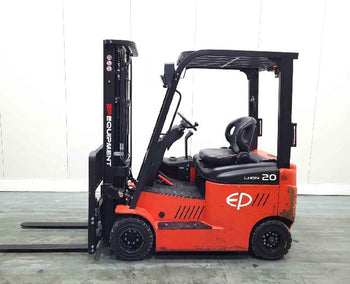
Counterbalance forklifts and reach trucks are quoted per enquiry. The range is simply too wide for one headline figure to be useful. Our counterbalance fleet runs from the 1500kg EP CPD15TVL three-wheel truck up to the EP CPD45F8 4.5 tonne forklift, and a 6.5 metre EP CQD16L reach truck sits in a different bracket again.
What moves the price
Five things account for most of the difference between two quotes for what looks like the same truck.
-
Hire length. The longer the commitment, the lower the weekly rate.
-
Capacity and mast. A triplex mast lifting to 4.8 metres costs more than a duplex at 3.3 metres, and the same goes for each step up in rated capacity.
-
Attachments. Side shift, fork positioners and rotators all add to the rate.
-
Hours of use. A truck working two shifts wears faster than one used for an hour each morning, and rates reflect that.
-
New or ex-demo. Ex-demo trucks can bring the cost down if you don't need a brand new machine.
Of the five, hours are the one people most often leave out when asking for a price, and it is the one most likely to change the final bill.
Reading "from" prices properly
Advertised "from" rates across the market tend to assume the best possible conditions for the supplier: a long contract, a basic specification and light annual usage. Few real operations match all three.
It is worth doing the maths on your own hours before comparing quotes. A truck on a single eight-hour shift, five days a week, will clock roughly 2,000 hours over a working year. If a quote is built around a fraction of that, the cheap weekly rate will not survive contact with your site.
Short-term vs long-term forklift rental
Short-term hire suits anything with an end date. Peak season, a stocktake, a racking refit, cover while your own truck is off the road, or a trial before you commit to buying a particular model. You pay more per week, and in return you can off-hire when the work is done.
We can supply a truck for a single day if it is booked far enough in advance, as well as by the week or for several months.
Long-term hire, often called contract hire, usually runs for a year or more. The weekly rate drops, servicing is built in and your costs are fixed, which makes budgeting simpler. The catch is commitment. If your volumes fall or you move sites, ending a contract early can carry a charge, so read that clause before you sign.
If you are weighing up a multi-year hire, compare it against buying outright or financing. Over a long enough period, ownership can work out cheaper, particularly for lighter-use equipment like pallet trucks.
Why lithium-ion changes the calculation
With older lead-acid trucks, multi-shift work often meant hiring a second battery and finding space for a changing area. All of our hire fleet is EP lithium-ion, and these batteries can be opportunity charged during breaks and shift changes without damaging them. In practice, one truck can often cover work that would once have needed two batteries or two trucks. There is also no battery watering or acid handling to manage, which matters on a short hire where nobody on site has used the truck before.
Matching the truck to the job
Hiring the wrong type of truck is the most expensive mistake on this list, because you pay for it every week. A rough guide to what each type is for:
-
Electric pallet trucks move pallets along the ground: loading bays, trailers and short runs across a warehouse floor. They don't lift to height.
-
Pallet stackers lift pallets onto lower racking, typically up to around three metres. They suit smaller stores where a counterbalance would be overkill.
-
Counterbalance forklifts are the general-purpose option. They load and unload vehicles, work in yards as well as indoors and handle the widest range of loads. Three-wheel models turn tighter, while four-wheel models give more stability for heavier work.
-
Reach trucks are built for high racking in narrow aisles. If you are storing pallets at six metres and above, this is usually the right choice.
-
Order pickers lift the operator to the shelf to pick individual items rather than whole pallets.
If your work covers more than one of these, it is often cheaper to hire two simpler trucks than one larger machine that does everything adequately.
The terms worth checking before you sign
Hire agreements are rarely exciting reading, but most disputes come from a handful of clauses. These are the ones to look at closely.
Hours allowance
Many hire agreements include an hours allowance tracked on the truck's hour meter, with an excess charge if you go over. Ask what the allowance is, how the excess is calculated and when the meter will be read.
Damage and insurance
The hirer is normally responsible for damage beyond fair wear and tear while the truck is on site. Check that your business insurance covers hired-in plant, and take dated photos of the truck on delivery so there is no argument about existing marks.
Servicing and breakdowns
Find out who carries out routine servicing, how quickly an engineer will attend if the truck stops, and whether a replacement is supplied while it is being repaired. With us, support and parts are part of the hire, and our technicians attend on site if something goes wrong.
[IMAGE: Engineer carrying out a service inspection on an electric pallet stacker in a warehouse]
Thorough examination
Forklifts are lifting equipment, so they need a thorough examination under LOLER. HSE guidance sets this at least every 12 months, or every six months for equipment used to lift people, which includes order pickers. The hire company usually arranges it, but HSE is clear that legal responsibility sits with the user. Ask for the current Report of Thorough Examination on delivery, and on a long hire, note when the next one falls due.
Charging
Confirm what the truck needs to charge before it arrives. Smaller pallet trucks and stackers often charge from a standard socket, while larger counterbalance trucks may need a dedicated charger and a suitable supply. Finding this out on delivery day wastes a day of hire.
Off-hire and collection
Check how much notice you need to give to end the hire, whether the rate stops on the day you call or the day the truck is collected, and what condition it needs to be in when it goes back.
It also helps to be there when the truck is collected. A quick walk round with the driver, compared against your delivery photos, settles most condition questions before they turn into an invoice.
Operator training on hired trucks
There is no forklift "licence" in the way there is a driving licence. What the law requires is that operators are trained, competent and authorised by their employer for the type of truck they use. HSE's L117 Approved Code of Practice sets out what that training should cover.
Hiring a truck does not transfer this duty to the supplier. If your operators are trained on counterbalance trucks and you hire a reach truck, they need training on that truck type. Even on a familiar type, a short familiarisation on the specific model is good practice, because controls, mast behaviour and battery displays vary from machine to machine.
Availability and lead times
We hold more than 250 trucks in stock and deliver across the UK using our own transport team, with delivery included in the hire.
Availability is usually best when you book ahead. Demand tends to rise in the run-up to Christmas, when warehouses and distribution centres take on seasonal volume, so if you know you will need extra trucks in autumn, it pays to arrange them early.
For urgent cover, such as your own truck breaking down, call us and we will tell you straight away what we can get to you and when. Ex-demo trucks are also available for hire and are worth asking about if you need something quickly.

How to get an accurate rental quote
The more detail you give upfront, the closer the first quote will be to the final price. Before you get in touch, it helps to know:
-
The heaviest load you will lift and the pallet sizes involved
-
The highest racking level the truck needs to reach
-
Aisle widths and the floor surface, whether indoors or outside
-
How many hours a day the truck will work, and how many shifts
-
How long you need it for, and your site address
A few photos of the area the truck will work in are useful too, especially of tight corners, ramps, dock levellers or doorways with limited headroom. A mast that clears your racking but not your goods-in door is a problem nobody wants to discover on delivery day.
If you are not sure which type of truck the job needs, tell us what you are moving and where, and we will recommend one.
Ready to hire?
Electric forklift rental gives you the equipment without the capital outlay, and with the right terms in place, it keeps costs predictable. Check the hours allowance, the damage terms and the paperwork, and match the truck to the job rather than the cheapest headline rate.
You can browse our full range and send a rental enquiry on our electric forklift hire page, or call the team on 01600 800 800.