

Why this choice matters for hire
If you’re arranging hire for a warehouse, retail backroom, production area, or a short-term project, the “right truck” is rarely about getting the biggest machine. It’s about matching duty level, lift height, and space to the job so you don’t overpay, bottleneck your aisles, or create avoidable safety risks. iLift positions its rental offering around electric trucks and pallet-handling equipment for short- and long-term hire, which makes the electric pallet stacker vs forklift decision especially relevant for indoor operations.
This article is written for people searching variations of electric stacker hire vs forklift and stacker vs counterbalance hire—in other words: you’re not just comparing machines, you’re trying to choose the most sensible hire for your workload.
What each machine is designed to do
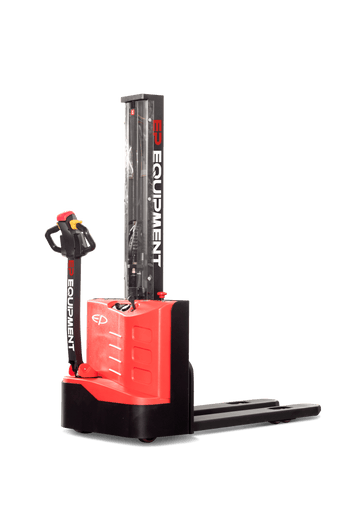
An electric pallet stacker is often described as a “hand forklift”: it’s built to transport pallets and lift them into racking, typically with a pedestrian operator (walk-behind) or a compact ride-on format. iLift’s own explanation aligns with that: stackers are commonly used in confined warehouse spaces and can lift and store pallets at higher levels than a standard pallet truck.
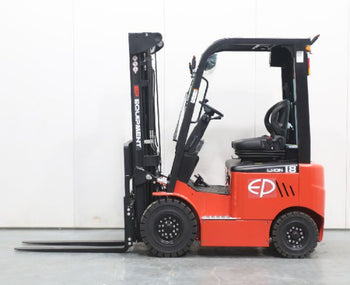
A forklift (in the hire conversations most people mean a counterbalance forklift) is designed to pick up loads on front forks, with the weight balanced by the truck’s counterweight. The UK Materials Handling Association explains that counterbalance trucks are highly flexible, can be used indoors and outdoors, and commonly sit in a 1,000–3,000 kg capacity bracket with 3–6 metres (or more) of lift height depending on mast configuration.
A useful way to think about the distinction is this: stackers are usually the “light-to-medium duty, space-efficient storer”; forklifts are usually the “heavy-duty, all-rounder loader/unloader”—especially when outdoor travel, yard surfaces, or lorry work enters the picture.
Lift height and load: what “light-duty vs heavy-duty” looks like
For rental buyers, “light-duty” usually means lower weights, moderate lift heights, shorter travel distances, and a lot of start-stop handling. “Heavy-duty” tends to mean heavier loads, higher utilisation, more frequent lorry work, and more operating hours per day (which also changes how you think about batteries, charging, and uptime). iLift’s hire content frames forklift choice around the application and load weight, and highlights lithium-ion benefits such as reduced maintenance and quicker charging compared with lead-acid in many warehouse contexts.
To make the comparison concrete, here are two real examples from iLift’s catalogue (specs and hire figures are published on the product pages):
-
The ES12-12ES electric pallet stacker is positioned for light-duty warehouse work: 1200 kg capacity and 3000 mm (duplex mast) lift height, with “rental from £150/week”.
-
The EFL181 electric forklift is a counterbalance model at 1800 kg capacity with 3300 mm (duplex) or 4800 mm (triplex) lift height options, with “rental from £165/week”.
If your job is essentially “store pallets to second-tier racking” and your loads are within a stacker’s rating, a stacker can be the right fit. If you need more lift height, heavier loads, or more flexibility across different working areas (including outdoor capability), a forklift becomes more justifiable.
Two important nuance points for hire decisions:
First, stackers can go higher than many people assume. EP Equipment notes lift-height options for its ES-WA series reaching 2.5 m to 5.5 m, which moves some stackers into “serious racking” territory (with the right model and conditions).
Second, forklifts don’t just scale up a little—they can scale up a lot. For example, iLift lists the EFL253/303/353 series at 2,500–3,500 kg capacities, with mast options including up to 6,500 mm on certain configurations. This is the point where the equipment stops being “a better stacker” and becomes “the right tool for heavy-duty work”.

Space and manoeuvrability: why footprints and turning radius decide the hire
Space constraints are often the difference between “this will transform our flow” and “we hired the wrong thing and now nothing fits”.
The simplest, practical measures to compare are:
-
Overall width (how much of your aisle the truck itself consumes)
-
Overall length (how much space it needs to position)
-
Turning radius (how tight it can turn—especially important at aisle ends, cross-aisles, and doorways)
Using iLift’s published specifications:
-
The ES12-12ES stacker shows overall width 800 mm, overall length 1740 mm, and a 1408 mm turning radius.
-
The EFL181 forklift shows overall width 1080 mm, overall length 2935 mm, and a 1920 mm turning radius.
That difference is not subtle. In a narrow warehouse, the stacker’s smaller footprint can mean the difference between maintaining two-way traffic (or at least passing points) and having to re-route pedestrians and pickers to avoid choke points. iLift’s own material on choosing stackers vs forklifts emphasises stackers’ compactness and manoeuvrability for tight warehouse spaces.
A related, real-world space question is: are you trying to “turn into the pallet” or “approach straight-on”? Walkie stackers often work well when you can approach relatively straight in tight aisles (because the truck is narrower), whereas counterbalance forklifts demand more room for turning, squaring up, and correcting. The right-answer hire isn’t always the smallest truck—it’s the truck that matches your route geometry.
When an electric pallet stacker is the better hire
Choose an electric pallet stacker when your operation looks like most of the following:
You need moderate stacking height (often around 3 m in many light-duty stackers) and you’re primarily putting pallets away or retrieving them within a warehouse, rather than doing constant lorry work. For example, iLift’s ES12-12ES is positioned at 3 m lift and 1.2 t capacity for light-duty work.
You have tight aisles, short turning areas, or awkward doors/lifts. The stacker footprint advantage is measurable: the ES12-12ES turning radius and width sit well below the EFL181 example.
You’re handling lighter pallets and lower cycle intensity where a compact pedestrian unit is easier to deploy, easier to park, and less disruptive to pedestrian routes. iLift specifically positions stackers as simpler to use than standard ride-on forklifts for confined warehouse environments.
You also need to match the stacker type to your pallets. For non-standard pallets (including scenarios where straddle legs matter), a straddle-arm stacker can be appropriate; iLift’s ES-WA series description highlights adjustable straddle arms and suitability for various pallet sizes and warehouse/manufacturing environments.
Finally, stackers can be cost-effective for hire when what you really need is “lift and store” rather than “lift, travel far, and unload lorries repeatedly.” iLift’s published weekly hire starting points show stackers in the same general “from” band as smaller forklifts, so the cost decision often comes down to capability fit rather than a simple “stackers are always cheaper” assumption.
When a forklift is the better hire
Choose a forklift (especially a counterbalance) when your job demands more versatility across surfaces and tasks.
If you’re unloading vehicles, working around a yard, or moving between indoor and outdoor areas, a counterbalance forklift’s design is built for broader operating conditions. The UKMHA notes counterbalance trucks’ indoor/outdoor flexibility and the ability to fit attachments, which is part of what makes them a “do more jobs” hire.
If your pallets are heavier and more frequent, or you’re moving bulky loads that push you beyond typical light-duty stacker duty cycles, the forklift becomes the safer and more productive choice. iLift’s forklift range includes higher-capacity options such as the EFL253/303/353 series at 2.5–3.5 t and with higher lift configurations up to 6.5 m, which speaks directly to those heavier use cases.
If you need higher lift heights with more cushion, forklifts again tend to be the simpler answer—particularly where you’re stacking at height with heavier pallets (because both stability management and rated capacity at height matter). Even within iLift’s “entry” forklift range, the EFL181 offers 3.3–4.8 m options, while heavier series offer more.
Also consider operator experience and ergonomics. In many operations, a forklift’s seated operator position and higher travel speed can be a better fit for longer travel routes and multi-shift work. iLift’s EFL181 specifications include travel speed figures and operational details consistent with that role.

Safe hiring: training, inspections, and a practical decision checklist
Whatever you hire, the legal and practical expectation is the same: operators must be trained and competent, and the equipment must be properly maintained and examined.
The Health and Safety Executive is explicit that people using equipment at work must be adequately trained for safe use, supervision, or management. For lift trucks specifically, HSE guidance stresses that employers should ensure operators are trained to the standards outlined in the ACOP (L117). The core reference many UK sites work from is Rider-operated lift trucks: Operator training and safe use (L117), which sets out expectations around lift-truck operator training and safe use.
On inspections and statutory examination, HSE states that thorough examination of industrial lift trucks is required under LOLER 1998 (for lifting equipment) and that PUWER 1998 covers other safety-related items such as brakes, steering, and tyres—while clarifying that routine maintenance inspections are not the same as a thorough examination.
A simple checklist that usually gets you to the right hire choice:
If the job is mostly ground-level movement, consider adding a pallet truck rather than overusing a forklift (often a better productivity and cost outcome), and iLift notes that pallet trucks can be hired alongside forklifts as part of “split task” planning.
If you need stacking to around 3 m and you’re tight on space, a stacker is often the best starting point, especially pedestrian models designed for minimal working space.
If you need regular lorry loading, mixed indoor/outdoor travel, or heavier pallets, shortlist a counterbalance forklift and match the capacity and mast height to the load and racking.
Hire or buy from iLift
If you want to compare options quickly on iLift, these pages map neatly onto the decision:
-
Browse stackers: Electric Pallet Stackers
-
Browse forklifts: Electric Forklifts
-
Add a pallet truck for high-volume ground moves: Electric Pallet Trucks
-
For short- and long-term rental enquiries: Electric Forklift Hire
If you already have a likely match, these specific examples show the “stacker vs forklift” difference in real specs and hire starting points: