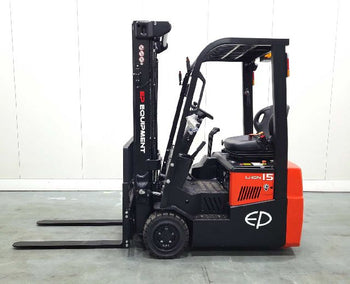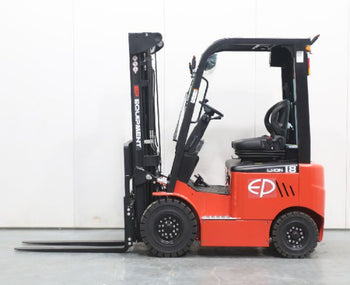


Ask any warehouse manager which truck they would keep if they could only have one, and a lot of them still say the counterbalance. Reach trucks, articulated trucks and very narrow aisle kit all have their place, and each one solves a specific problem. But the counterbalance forklift remains the workhorse of British warehousing for good reason. Knowing when to use a counterbalance forklift, rather than defaulting to whatever the site already owns, is one of the simpler ways to lift throughput without overspending on the wrong machine.
This guide walks through where the counterbalance still comes out on top, where it does not, and how to match the truck to the job.

What a counterbalance forklift actually does well
The design is in the name. A counterbalance forklift carries a heavy weight at the rear to offset the load on the forks, so there is no need for outriggers or stabilising legs at the front. The forks sit at the very front of the truck, which means the machine can drive straight up to a pallet, a stack or a lorry bed and pick it up with nothing in the way.
That simplicity is the whole point. A counterbalance is quick to learn, quick to service and quick to move loads from A to B. For most general handling work, it does the job with less fuss than a more specialised truck.
The strengths that keep it relevant come down to a few things:
-
Direct load access. No outriggers means the truck approaches loads face on, which suits ground-level stacking, block storage and loading bays.
-
Outdoor and indoor capability. With the right tyres, a counterbalance moves between the yard and the warehouse floor without swapping machines.
-
Higher residual capacity. Because it is built to carry weight rather than reach into racking, a counterbalance holds its rated capacity well, which matters for heavy or awkward loads.
-
Straightforward operation. Shorter training time and fewer failure points keep sites running.
When to use a counterbalance forklift
The honest answer is most of the time, on most general sites. But it helps to be specific. A counterbalance is the right call when the work looks like this.
Loading and unloading vehicles
Anything involving a lorry, a container or a flatbed plays to the counterbalance's strengths. The forks reach into the vehicle without legs getting in the way, and the truck can handle the transition from yard to dock. Reach trucks were never designed for this, which is why even sites that run reach trucks inside keep a counterbalance at the loading bay.
Mixed indoor and outdoor work
If pallets come off a vehicle in the yard and need to travel into the building, a counterbalance does both ends of that journey. Splitting the task across two truck types adds handling, adds cost and adds the risk of a bottleneck at the door.
Heavy or non-standard loads
When loads are heavy, long or oddly shaped, capacity and stability matter more than reach height. A counterbalance built for the weight will carry a full load with margin to spare. If your loads are pushing the limits of a lighter truck, it is worth checking the numbers on our capacity page before you commit to a machine.
Wider aisles and lower racking
Counterbalance trucks need more room to turn than a reach truck, so they suit sites with aisles of roughly 3.5 to 4 metres and racking that does not run especially high. Plenty of real warehouses look exactly like this, particularly in manufacturing, distribution and trade supply.

Where a reach truck makes more sense
Being clear about the limits is the fastest way to make the right choice. A counterbalance is not the answer to everything, and pretending otherwise costs sites money in wasted space.
The counterbalance gives up ground in two areas. First, aisle width. Because the counterweight sits behind the rear axle, the truck has a large turning circle and needs wide aisles to operate safely. Second, lift height. Standard counterbalance trucks are not built to place pallets at the top of high racking with the same precision and reach as a dedicated machine.
This is exactly where the reach truck earns its keep. It uses a moving mast and stabilising legs to work in aisles as narrow as 2.5 to 2.8 metres and to lift loads far higher, which lets a site pack in more racking and store more stock in the same footprint. If your priority is storage density and vertical space, that is the trade you want.
We cover this comparison in more detail in our reach truck blog, which is worth reading if you are weighing storage capacity against handling flexibility.
The point is not that one truck beats the other. It is that they solve different problems. Many warehouses run both, using reach trucks to feed the racking and counterbalance trucks to move goods in and out.
Electric counterbalance and the running cost question
There is a second decision hiding inside the first one. Choosing a counterbalance used to mean choosing between a diesel or LPG engine for power and an electric truck for clean indoor running. That trade-off has largely gone.
Modern lithium-ion electric counterbalance trucks match the performance most sites need while cutting the drawbacks that put people off older electric models. Lithium-ion batteries charge fast, top up during breaks without a dedicated charging room, and hold performance through the shift rather than fading as they drain. There are no fumes, so the same truck that unloads a lorry in the yard can drive straight into the building.
For a lot of operations, that removes the last reason to run engine-powered trucks indoors. Lower running costs, less maintenance and no emissions on the warehouse floor add up quickly across a fleet. You can see the range of EP lithium-ion counterbalance models on our product collections.
Matching the truck to your site
Before deciding, it helps to run through a short checklist. The answers point clearly towards a counterbalance or away from it.
-
How wide are your aisles? Around 3.5 metres or more suits a counterbalance. Under 3 metres and you are into reach truck territory.
-
How high do you store? Ground level and lower racking favour the counterbalance. Tall racking favours a reach truck.
-
Do you load vehicles? If yes, you almost certainly need a counterbalance somewhere on site.
-
Indoor, outdoor or both? Mixed work is the counterbalance's home ground.
-
How heavy are your loads? Match the rated capacity to your heaviest regular load, with margin.
Most sites do not fit neatly into one box, and that is fine. The goal is to build the right mix of trucks for the actual work, not to force everything through a single machine.
The bottom line
Counterbalance forklifts still win in warehouses because they are flexible, dependable and quick to run. Where the work involves loading vehicles, moving between indoors and out, handling heavy loads, or operating in normal-width aisles, nothing does the job as cleanly. Reach trucks pull ahead when storage density and lift height are the priority, which is why plenty of sites run both.
If you are deciding what to add to your fleet, start with the work you actually do rather than the truck you already have. Take a look at our capacity pages to check the numbers against your loads, browse the current range in our product collections, or hire a counterbalance to trial it on your own floor before you buy. If you are still weighing it against a reach truck, our reach truck blog lays out the comparison in full.