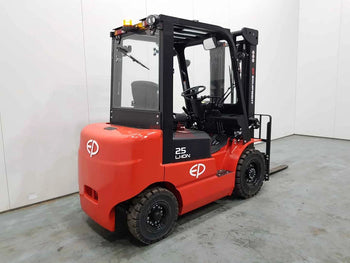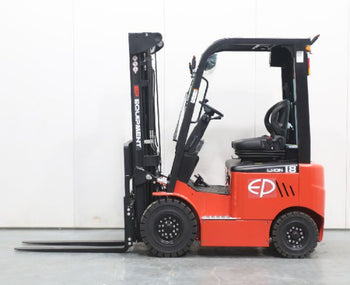


Choosing the right forklift starts with one question that almost every buyer eventually asks: what size forklift do I need? Get it wrong in either direction and you'll either be pushing a machine beyond its safe limits or paying to operate more truck than your operation actually requires. Getting it right means matching three things precisely: the weight of your loads, the height you need to lift them, and the environment you're working in.
This guide walks through each factor clearly, explains how capacity really works in practice, and helps you size with confidence before you spend a penny.
Understanding Forklift Capacity: It's Not Just About Weight
The number printed on a forklift's data plate, say, 2,000 kg or 3,000 kg is the rated capacity at a standard load centre. In the UK, a forklift's rated capacity assumes a standard load centre of 600 mm that is, the distance from the front face of the forks to the centre of gravity of the load.
In plain terms: the rated capacity only applies when the heaviest point of the load sits no further than 600 mm from the fork face. The moment your load is longer, oddly shaped, or lifted higher than the standard test height, that figure changes and is not in your favour.
This is the most important principle to grasp before sizing any forklift. The nameplate capacity is a starting point, not a guarantee.
How Lift Height Reduces Capacity
As the mast extends, the combined centre of gravity of the truck and load shifts higher and further forward, reducing overall stability. In practice, a forklift rated for a given capacity at low height may only manage significantly less at maximum lift height and always cross-check the load chart, not just the headline capacity figure.
If you need to stack loads at 5 metres or above, you'll likely need a truck rated at a higher capacity than the load weight alone would suggest, to retain adequate safe working load at full mast extension.
How Attachments Reduce Capacity
Fitting a sideshift, fork positioner, or any other attachment reduces the effective safe working load, a process known as derating. Derating happens for two reasons: the attachment itself adds weight to the front of the truck, and many attachments move the load further from the mast, which reduces capacity even more. Attachments do not increase your forklift's capacity; they allow you to handle different types of loads, but they reduce the rated capacity in the process.
A double pallet handler, for example, could reduce lifting capacity by 20–30%. The data plate must be amended to reflect any such changes. This is a legal requirement under LOLER and PUWER something your supplier should handle when specifying the truck.

Step 1: Know Your Maximum Load Weight
Start by identifying the heaviest single load you will ever need to lift not the average load, but the worst case. Then apply a safety buffer of 10–20% above that figure when selecting your rated capacity. A practical rule of thumb is to buy or hire a forklift with a slightly larger load capacity than what is actually needed. This headroom accounts for derating from lift height and any future changes to your load profile.
As a general guide for UK operations:
-
Up to 1,500 kg compact 3-wheel electric forklift; ideal for smaller warehouses, tight spaces, and lighter pallet work
-
1,500–2,000 kg the most common capacity range for general warehouse and logistics operations; covers the vast majority of standard pallet loads
-
2,000–3,500 kg medium-duty applications including manufacturing, distribution, and heavier goods
-
3,500–5,000 kg heavy-duty use; construction materials, metal stockholding, building supplies
-
5,000 kg and above specialist industrial applications; heavy machinery, large format goods, yard operations
iLift's EP electric forklift range covers this full spectrum, from the EP CPD15/18/20TVL series at 1,500–2,000 kg through to the EP EFL702 at 7,000 kg for the most demanding heavy-duty applications.
Step 2: Establish Your Required Lift Height
Once you know your load weight, the next question is how high you need to go. It is important to bear in mind that the higher the forklift stacks, the more the truck's capacity de-rates. So lift height and capacity are always considered together. Measure your highest required stacking height typically the top beam of your racking plus the height of the pallet and load. Your forklift needs to lift above that point to place a load safely, so factor in an additional 150–200 mm clearance above the top beam when specifying lift height.
Mast Types and What They Mean
The mast configuration determines how high a truck can lift while staying compact enough to work inside buildings and load through standard doorways. If lift trucks are to be used inside lorries, standard internal height is 2,600 mm; railway wagons 2,000 mm; and containers have a door height of 2,280–2,585 mm. Your mast's collapsed height needs to clear these entry points.
The three main mast types are:
-
Duplex (two-stage) moderate lift height with a lower collapsed height; a practical choice when clearance is tight but lift requirements are modest
-
Triplex (three-stage) the most common choice for racked warehouses; lifts high while keeping the collapsed mast compact enough for standard doorways and vehicles
-
Quad (four-stage) for very high racking or specialist applications where maximum lift height is critical
Most iLift EP models are available with 3,300 mm standard lift height and 4,800 mm extended options, with triplex masts available for applications requiring higher reach. If your racking exceeds 5 metres, discuss mast options with the team before ordering.
Step 3: Consider Your Operating Environment
Capacity and lift height get you to the right size but the environment determines the right type of truck.
Indoor Warehouse Operations
For clean, smooth warehouse floors, a 3-wheel electric counterbalance forklift is often the most practical choice. Small counterbalance forklifts with capacities of up to 2,000 kg excel in compact warehouses and confined spaces. The shorter wheelbase and tighter turning circle make them nimble in narrow aisles and around racking.
A 4-wheel electric counterbalance provides greater stability for heavier loads and is better suited to yard use or rougher internal surfaces.
Indoor and Outdoor Mixed Use
If your forklift needs to move between a warehouse and an external yard, a 4-wheel configuration handles the transition more reliably. Ensure the tyre specification matches your outdoor surface solid tyres for smooth concrete, pneumatic for more varied ground.
Aisle Width
Turning radius is the silent killer of productivity if ignored, especially when choosing a forklift for tight spaces. A standard sit-down counterbalance forklift typically needs around 10–12 feet (approximately 3–3.7 metres) of turning clearance. Measure your aisle widths before specifying. If your aisles are tighter than this, a 3-wheel truck or a reach truck may be the better solution.
Floor Load Bearing Capacity
Often overlooked particularly in older buildings or upper-floor operations. If lift trucks are to be used on your premises, you need to check the ceiling load-bearing capacity of the subfloor, especially in the case of multi-storey buildings. If several forklifts are in operation, the load on the floor increases and the maximum permissible load-bearing capacity must not be exceeded. A structural engineer should confirm floor ratings if there is any doubt.
A Practical Sizing Example
A food distribution business is running a single-shift warehouse operation. Their heaviest pallet load is 1,600 kg, their racking tops out at 4.2 metres, and their aisles are approximately 3.5 metres wide.
Working through the framework:
-
Load weight: 1,600 kg plus 15% safety margin = spec a 2,000 kg capacity truck
-
Lift height: 4.2 m top beam + 200 mm clearance = minimum 4,400 mm lift required; a 4,800 mm triplex mast covers this comfortably
-
Environment: Indoor warehouse with smooth concrete floors; 3.5 m aisles suit a 3-wheel electric counterbalance
The right match here would be something like the EP EFL201 a 2,000 kg lithium-ion electric counterbalance with 4,800 mm lift option and a compact turning circle well-suited to standard warehouse aisles.
FAQ: What Size Forklift Do I Need?
Can I use a 2,500 kg forklift to lift a 2,500 kg load?
In theory, yes but only at the standard load centre, at low lift height, and with no attachments fitted. In practice, you should always apply a safety margin and check the truck's load chart for your specific lift height before committing to a rated capacity.
Does the forklift weight itself matter?
Yes particularly for floor loading and when driving forklifts onto vehicles or ramps. A loaded forklift is significantly heavier than the load alone. Ramps and mobile bridges must also be taken into account as these reduce the effective load-bearing capacity of the surface beneath.
What if my loads vary widely in size and weight?
Specify your maximum load and worst-case lift height, then check the load chart confirms adequate capacity at that configuration. A truck slightly over-specified for lighter loads is far safer and more practical than a truck pushed to its limits on heavy ones.
Is a bigger forklift always better?
Not necessarily. A larger truck is heavier, has a wider turning circle, costs more to run, and may be harder to manoeuvre in tighter spaces. Match the truck to the actual requirement oversizing creates its own operational problems.
Do I need a different capacity for outdoor use?
Capacity ratings are tested on flat, even surfaces. Uneven ground, inclines, or wet surfaces all reduce effective stability. If you're operating outdoors on anything other than flat concrete, discuss this with your supplier it may influence both the capacity and the tyre specification you need.

Get the Right Truck from the Start
Answering the question of what size forklift you need comes down to four numbers: your maximum load weight, your required lift height, your aisle width, and your floor conditions. Work through those four points and the right specification becomes clear.
iLift's EP electric forklift range covers 1,500 kg to 7,000 kg capacity, with lithium-ion power across every model, a battery included as standard, and a 5-year battery warranty on every purchase. Whether you're specifying a single truck for a small warehouse or sizing a fleet for a busy distribution operation, our team can help you get it right first time.
Browse the full EP electric forklift range or get in touch with iLift for a no-obligation sizing conversation.