

Why this decision matters in warehouse operations
Pallet trucks sit behind most “floor-level” warehouse flow: receiving, replenishment, internal transfers and despatch. The decision between manual and electric isn’t simply whether a pallet can be moved; it’s whether it can be moved repeatedly, safely and predictably when the operation is under pressure.
In the United Kingdom, it’s also a manual-handling decision. The Health and Safety Executive defines manual handling as transporting or supporting a load by hand or bodily force, including pushing and pulling, and its guidance uses a pallet truck as a clear example of something being pushed or pulled. If you scale up pushes and pulls per shift, you also scale up fatigue and the likelihood of musculoskeletal strain. In its key figures for 2024/25, HSE reports 511,000 workers suffering from a work-related musculoskeletal disorder.
Renting changes the buying conversation. Hire lets you match the truck to today’s workload, cover seasonal spikes, and trial a powered solution in your own layout. iLift’s rental offer is built around flexible short- and long-term hire of electric forklifts and pallet trucks.
Manual pallet trucks: best for occasional, short, flat moves
A manual pallet truck (often called a pallet jack or pallet pump) is human-powered. You steer with a tiller-like handle and pump hydraulics by hand to lift the pallet just enough to travel. The appeal is simplicity: no batteries or charging routine, and minimal technical downtime.
Manual trucks still make sense when the task is genuinely light touch: short travel distances, smooth and level floors, low daily move counts, and predictable routes. In those conditions, the “grab-and-go” nature of a manual truck is a real advantage.
The limitation is rarely the rated capacity; it’s the force required to start, stop and steer a loaded pallet in real conditions. Road Haulage Association guidance for tail-lift deliveries notes that start/stop forces (pushing/pulling a loaded pallet truck) can exceed guideline figures as load weight increases, and that slopes, uneven floors and confined spaces can raise forces further. Where that describes your normal environment—ramps, dock plates, yard transitions, long runs—manual handling risk and productivity loss tend to rise together.
Electric pallet trucks: when “powered” becomes a control measure
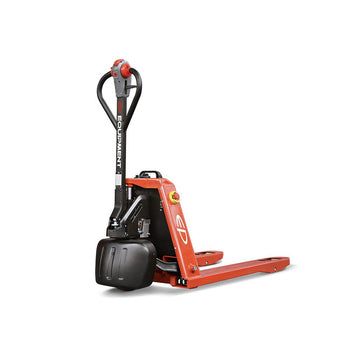
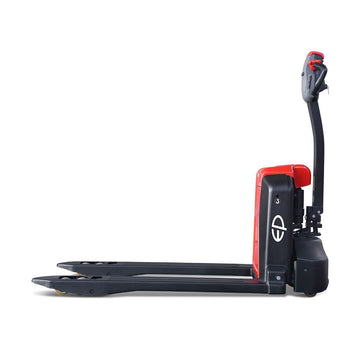
Electric pallet trucks add a battery and powered travel (and typically powered lift). That power does two things buyers care about: it reduces the physical effort of propulsion, and it keeps performance more consistent across a shift (less dependency on operator strength and fatigue). A practical bonus for indoor sites is that battery-electric pallet trucks avoid engine exhaust at point of use and are typically quieter than combustion alternatives, which can support communication in busy pick faces.
This aligns with HSE’s preferred approach to manual-handling risk: avoid hazardous manual handling where possible and, if you can’t avoid it, mechanise the task to remove or reduce the manual element. HSE’s manual handling guidance explicitly points to mechanical aids—including electric-powered pallet trucks—as a way to reduce injury risk.
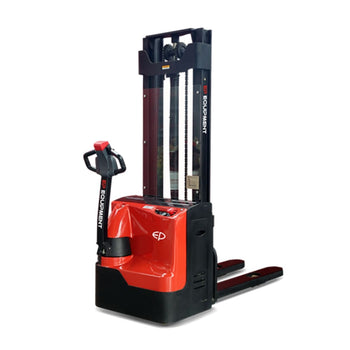
Electric pallet trucks also come in “tiers”. Walk-behind pedestrian trucks are a common upgrade from manual for dock work and internal moves. Ride-on trucks are built for longer internal travel and higher throughput, often adding features such as power steering and higher travel speeds to keep pallet transfers efficient at scale.

Productivity and total hire value
Productivity differences show up where warehouses actually struggle: distance, frequency, and route difficulty. HSE’s pushing/pulling guidance highlights that required force rises when conditions aren’t ideal—poorly maintained equipment, uneven/soft surfaces, and ramps or slopes all increase effort. UK delivery guidance adds that heavy loads can push start/stop forces beyond guideline figures even under good conditions, and “real world” conditions can increase forces considerably. If your route includes slopes, rough transitions, dock edges, or long travel, power assistance is often the quickest way to stabilise output.
That’s where powered pallet truck productivity becomes measurable. Focus on wins you can track: fewer micro-pauses when starting and steering, steadier output late in shift, and less need for manual workarounds (like two-person pushing).
Cost-wise, a practical rental comparison is “weekly hire cost versus labour saved and risk reduced”. On iLift’s current range, entry-level electric pallet truck hire is listed from £60 per week (ex VAT), with many pedestrian warehouse pallet trucks listed from around £150 per week (ex VAT). More specialised or heavier-duty pedestrian and rider options are listed higher—commonly around £180–£200 per week (ex VAT), depending on the model.
Battery strategy can matter as much as the hire rate. Lithium-ion equipment is commonly selected for “opportunity charging” (short top-ups between tasks) to reduce downtime. EP Equipment promotes opportunity charging and rapid charging on lithium-powered pallet trucks as a way to support multi-shift productivity; iLift’s own guidance similarly frames frequent top-ups as helpful for uptime.
Safety, training and risk assessment
A useful rule is: manual trucks concentrate risk in manual handling; powered trucks reduce manual handling effort but increase workplace transport risk. Both need controls.
For manual handling, HSE expects employers to assess risk and reduce it so far as reasonably practicable. HSE provides tools for this, including the RAPP tool for pushing and pulling operations involving wheeled equipment. Delivery guidance also emphasises risk assessment that considers site conditions, load dynamics, floor conditions and the suitability/maintenance of the pallet truck.
For powered pallet trucks, training and supervision are essential. HSE is clear that there is no such thing as a “lift-truck licence” in UK law, but employers must ensure operators are adequately trained and competent. HSE outlines a three-stage structure for lift-truck training (basic, job-specific and familiarisation). HSE also warns that lift trucks are “particularly dangerous” and involved in about a quarter of workplace transport accidents, with poor supervision and lack of training frequently contributing factors.
In procurement terms, renting electric should be paired with simple controls: pedestrian segregation where possible, speed management in high-traffic aisles, clear right-of-way rules, and basic daily checks (wheels, forks, brakes, battery/charger condition).

iLift hire options and a quick selection approach
If you’re weighing manual vs electric pallet truck hire, a fast selection approach is to start with your busiest day and your hardest route. If you can confidently say “short distance, flat, low frequency, predictable”, manual hire may still be enough. If you can’t, rent powered and measure output (pallet moves per hour) and fatigue over a week.
iLift’s electric pallet truck range covers the main warehouse hire scenarios:
- The F Series (entry-level powered assistance): hire from £60 per week (ex VAT).
- EPL1531 (core walk-behind, 1,500 kg): hire from £150 per week (ex VAT), positioned as a replacement for traditional hand pallet trucks.
- EPL154/185 (higher-frequency pedestrian): marketed as a next-generation walk-behind; hire listed from £150 per week (ex VAT) on iLift’s range page.
- WPL202 (confined/chilled, 2,000 kg): hire from £180 per week (ex VAT) and described as suitable for congested spaces and refrigerated warehouses.
- EPT WA Series (heavy-duty pedestrian, 2,000–2,500 kg): hire from £150 per week (ex VAT).
- RPL201/251/301 (ride-on, 2,000–3,000 kg): hire from £180 per week (ex VAT), described as supporting opportunity charging and electric power steering.
If your operation feels borderline, de-risk the decision with a one-week trial—rent the powered model that matches your busiest day and compare pallets per labour hour, operator fatigue, and near-miss/incident reports. Start with iLift’s electric pallet truck range page and hire enquiry workflow.